
CIPLE and where it fits in the Portuguese language certification system
Can you prove you speak enough Portuguese to become a citizen with just a handful of words like “obrigado” and “bom dia”? No, and that’s exactly why an exam like CIPLE exists.
CIPLE stands for Certificado Inicial de Português Língua Estrangeira, and it’s the exam most foreign residents run into when they start looking into Portuguese citizenship or residency. It tests basic, practical Portuguese: understanding a simple conversation, filling out a form, reading a short notice, asking for directions. It sits at level A2 on the Common European Framework of Reference for Languages, the same scale used across Europe to grade language ability from A1 (beginner) up to C2 (near-native).
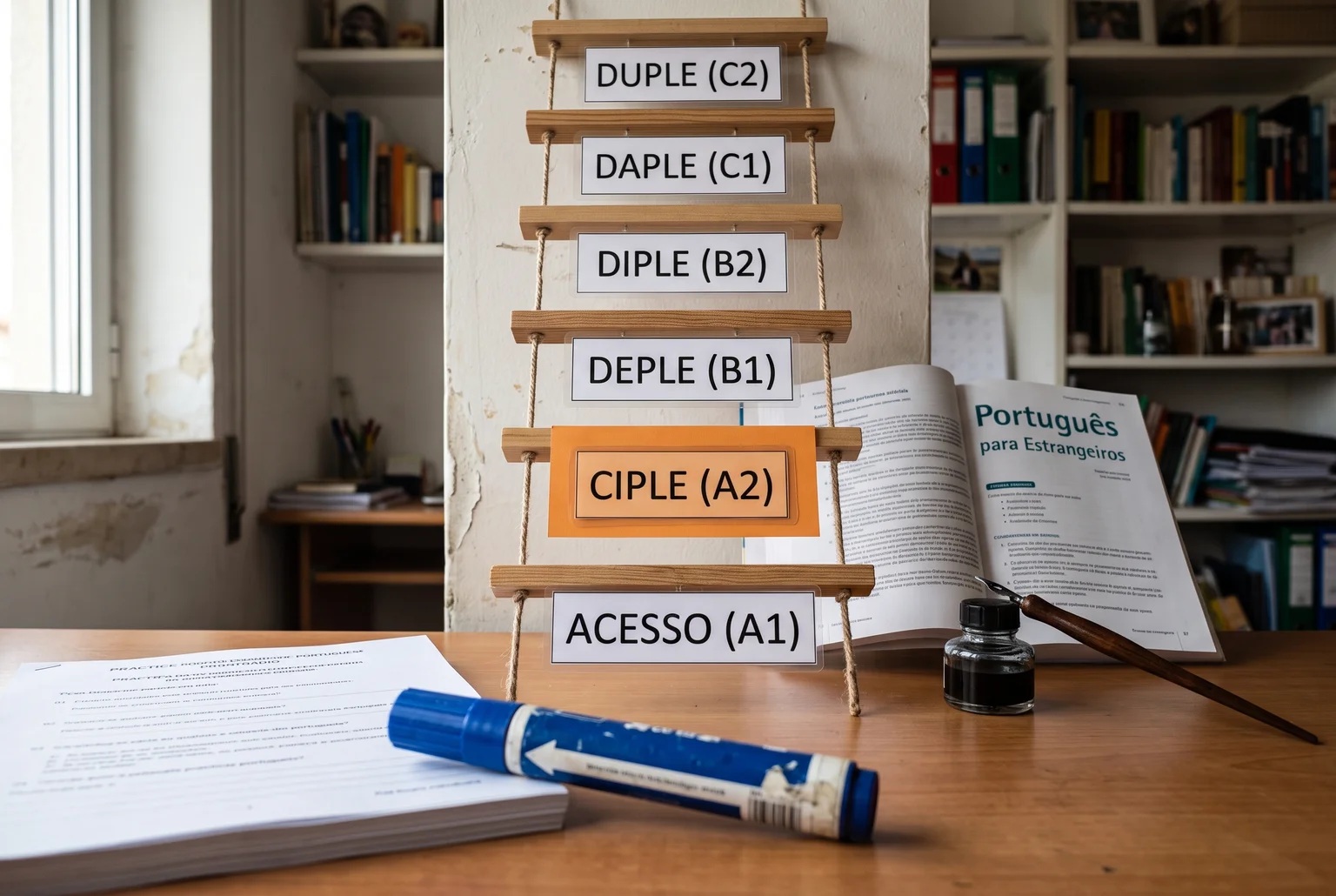
CIPLE doesn’t stand alone. It’s one exam in a family run by CAPLE, the Centro de Avaliação e Certificação de Português Língua Estrangeira, an academic unit inside the Faculty of Letters at the University of Lisbon. CAPLE runs exams at every level: CIPLE at A2, DEPLE at B1, DIPLE at B2, DAPLE at C1, and DUPLE at C2, with some materials also listing an entry-level A1 exam called ACESSO. For most citizenship applicants, CIPLE is the only one that matters, since A2 is the minimum bar the law asks for.
What makes CAPLE worth paying attention to is that it isn’t one of several competing options. CAPLE describes itself as the only Portuguese entity that evaluates and certifies written and oral competence in Portuguese as a foreign language for purposes including study, work, and citizenship acquisition. If you’re submitting a language certificate as part of a nationality or residency file, it needs to trace back to this system, not to a random online course with no accreditation behind it.
That’s the practical reason CIPLE matters so much to people reading this guide. Portuguese nationality law lists a recognised language qualification as one accepted way to show you meet the language requirement, and CIPLE is built specifically to produce that qualification at the A2 level. It isn’t an academic exercise or a school grade. It’s a certificate meant to be handed to a government office as documentary proof.
None of this means CIPLE is the only route to that same A2 proof, and it isn’t always required in every case. The next section covers when the requirement actually applies, and what other paths exist besides sitting the exam itself.
Who actually needs to prove A2, and how
Portuguese nationality law requires applicants for ordinary naturalisation to demonstrate sufficient knowledge of the Portuguese language. Under the current rules, nationals of Portuguese-speaking countries can apply for naturalisation after at least seven years of legal residence in Portugal, while nationals of other countries generally need at least ten years of legal residence.
Language requirements also arise in other nationality routes, although the exact proof required depends on the basis of the application. For example, knowledge of Portuguese can be relevant in applications through marriage or civil partnership with a Portuguese citizen. Nationals of Portuguese-speaking countries may, however, benefit from different rules regarding proof of language knowledge.
Residence permits are a separate immigration matter. Someone simply renewing a residence permit is not subject to the same language-proof requirements as someone applying for Portuguese nationality.
Take a concrete case: a British citizen married to a Portuguese national of origin for five years, applying for nationality by marriage, may use proof of sufficient knowledge of Portuguese to have her effective connection to the Portuguese community automatically recognised, even if she has never taken a formal Portuguese course. Compare that to an Indian software engineer on a work visa who has lived in Porto for 10 years and is now filing under ordinary naturalisation. Both need the same A2 proof, but they’ll likely reach it through different routes.
CIPLE is one accepted route, not the only one. A qualification certificate from a recognised public, private, or cooperative educational establishment can also satisfy the requirement, provided the applicant completed at least two academic years of a Portuguese or Portuguese as a Non-Native Language course. That’s a different path than sitting a single exam: it rewards sustained classroom attendance over test performance.
A more common alternative for recent arrivals is the Português Língua de Acolhimento (PLA) course system. Ordinance 183/2020 created PLA courses to replace the older PFOL courses, and Ordinance 184/2022 amended those rules. PLA courses certify CEFR levels A1 through B2, and a completion certificate at A2 or higher, issued by a public school, an IEFP centre, or a Qualifica Centre, counts as valid proof of Portuguese knowledge for nationality, permanent residence, and long-term resident status, per AIMA’s own guidance. In practice, this means someone who takes a structured 150-hour A1+A2 course through an approved provider walks away with a certificate that does the same legal job as a CIPLE pass, without sitting the CAPLE exam at all.
For those who prefer the PLA route as an alternative to the CIPLE exam, CIPLE School offers a reliable and flexible option, combining certified courses, high-quality teaching and schedules adapted to each student’s needs.
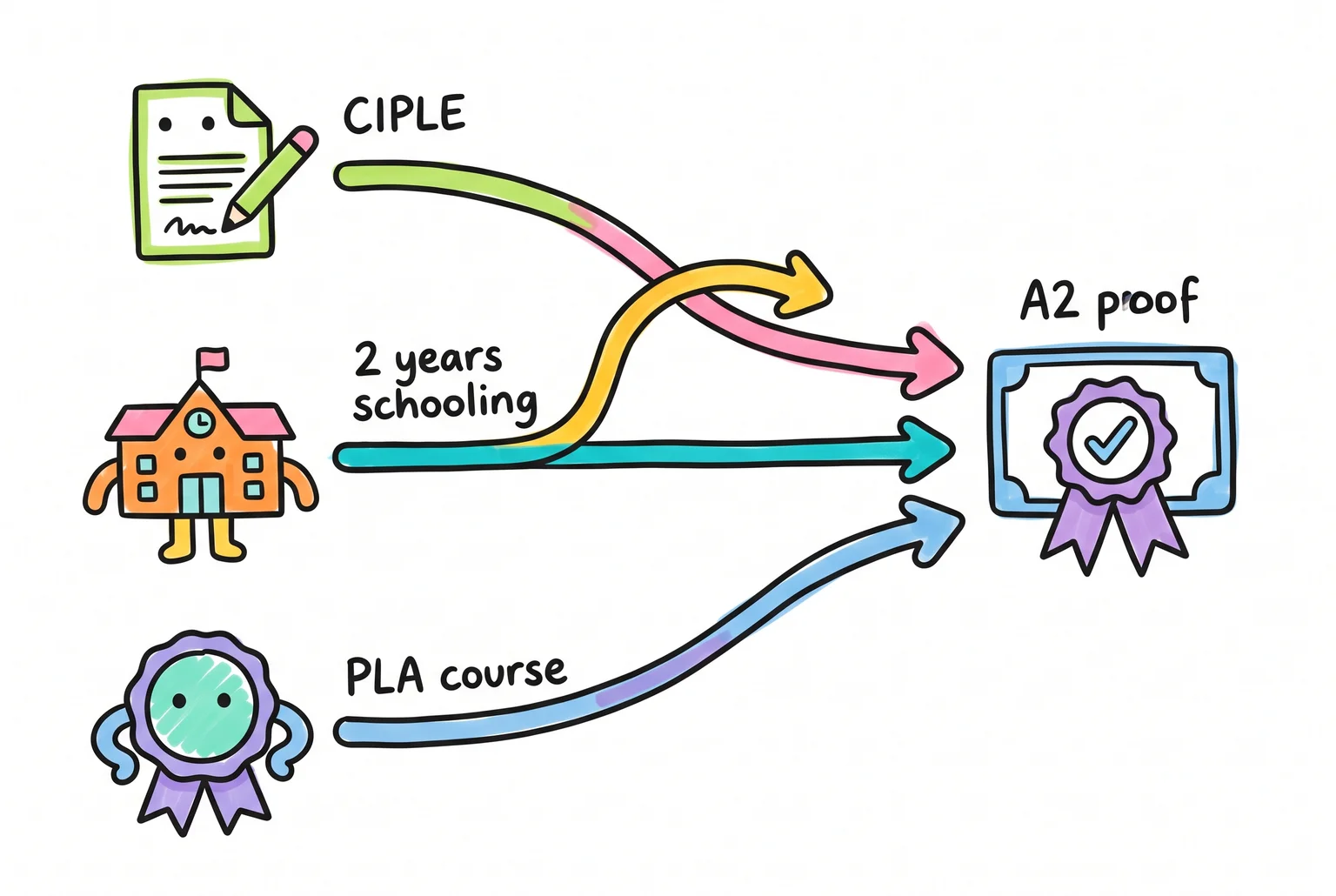
Three different paths, one accepted result: A2 proof does not require sitting for the CIPLE exam.
Other recognised certificates from public education, employment, or training centres can also work if they meet the applicable ordinance rules, and testing through Portuguese public schools or Camões-accredited centres abroad is sometimes cited as another route. None of these alternatives are guaranteed to fit every applicant’s situation. Acceptance can depend on the issuing institution, exact wording on the certificate, and how AIMA or the registry office reviewing the file interprets it that month. If you’re weighing PLA against CIPLE, check the current rules on caple.letras.ulisboa.pt and aima.gov.pt before committing time to either path, since course availability and administrative practice shift more often than the underlying law.
What the CIPLE exam actually tests on the day
CIPLE checks four skills through three scored components: reading and written expression, listening comprehension, and oral production and interaction. The exam is not four separate sittings. Reading and writing are combined into one paper, and listening and speaking are tested separately, according to CIPLE’s own exam description.
The reading and writing component runs about 1 hour and 15 minutes and counts for 45% of the final grade, the largest single share. Listening takes roughly 30 minutes and counts for 30%. Speaking takes about 15 minutes and counts for 25%. These figures come from CIPLE’s published exam breakdown, but timings and weightings are exactly the kind of detail that can shift between exam cycles, so confirm the current numbers on caple.letras.ulisboa.pt before you plan your study schedule around them.
Reading tasks use short, practical texts: advertisements, text messages, notices on a bulletin board, short emails. You might see a rental listing and have to answer true or false questions about it, or match five short notices to five short descriptions of what each notice is for. This is not literary Portuguese. It is the kind of text you’d actually run into living in Portugal, which is the point of an integration-focused exam.
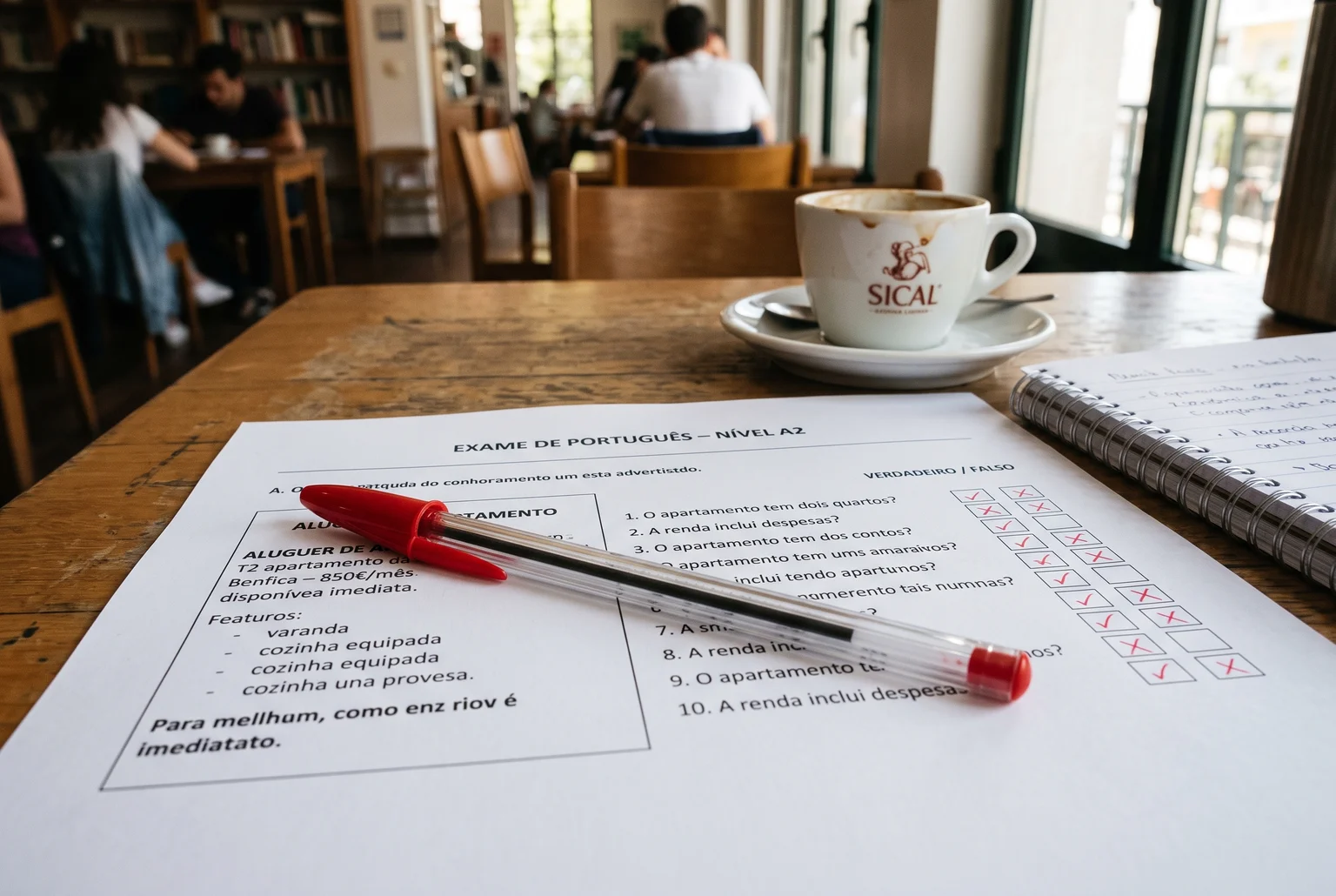
The writing half of that same component usually asks for two short pieces, commonly one in the 25 to 35 word range and a longer one around 60 to 80 words, such as writing a short message to a neighbour or a brief informal email. Exact word counts and task counts can vary by exam sitting, so treat those ranges as a general guide rather than a fixed rule, and check the current official sample materials if you want the precise figures for your exam date.
Listening comprehension plays short dialogues, monologues, or announcements, then asks multiple-choice or matching questions about what you heard. Think of an announcement at a train station, a voicemail message, or two people making plans to meet for coffee. You typically hear each recording more than once, though you should verify that detail against the official exam rules rather than assume it.
Speaking is the one component that happens face to face. A CIPLE candidate sits with an examiner, often alongside another candidate, and answers questions or takes part in a short interaction about everyday topics: your routine, your family, where you live, simple opinions. Many online sources and candidate write-ups describe this as conversational rather than a formal interview, focused on whether you can hold a basic exchange, not on grammatical precision. That said, the descriptions of specific speaking tasks, like role-plays or short monologues, come mostly from preparation guides and simulated practice materials rather than from a fully documented official sample, so go in expecting a conversation and let the examiner’s questions guide the shape of it.
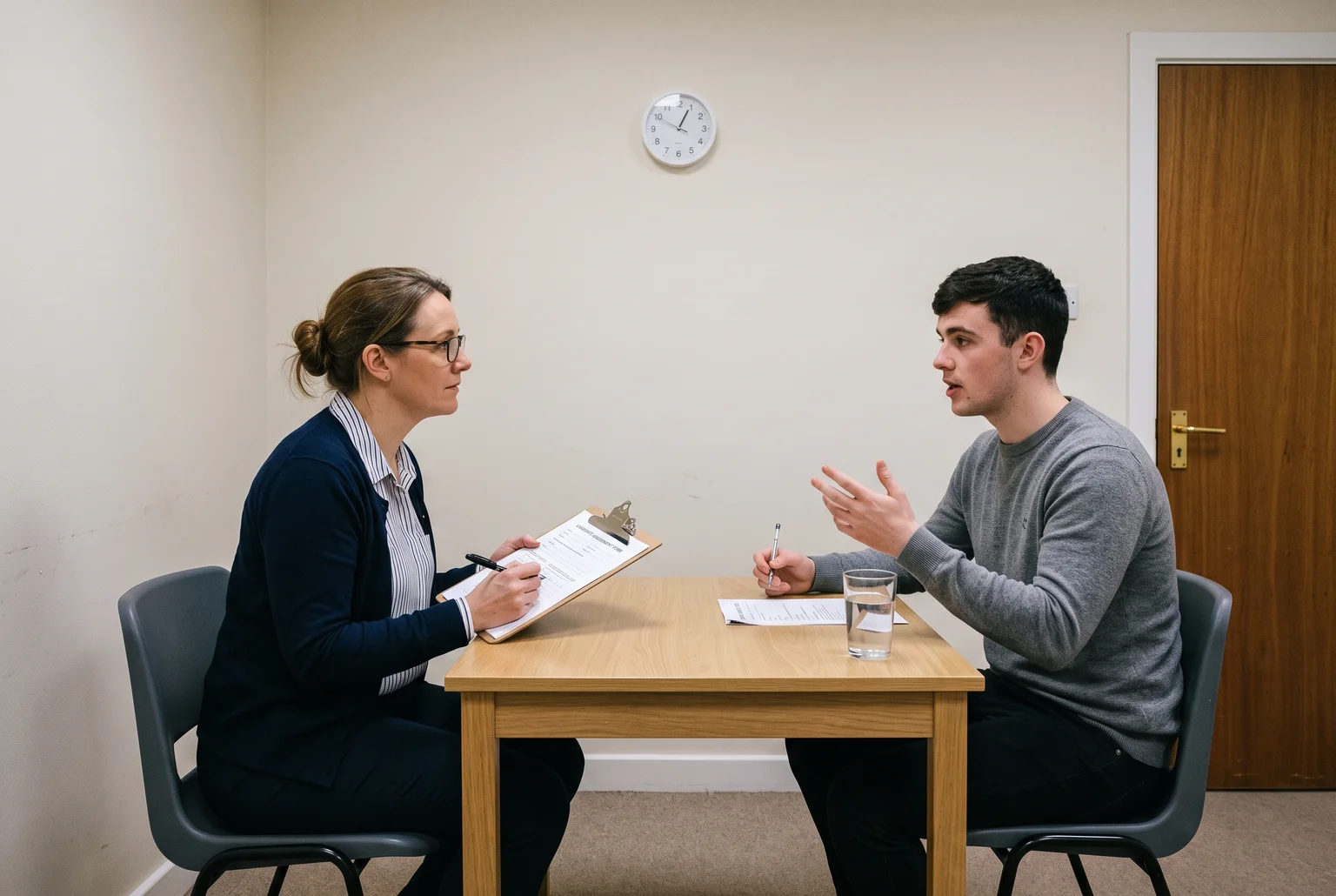
The speaking portion comes down to a short conversation across a table, not a scripted performance, so let the examiner’s questions set the pace.
If you want to see what any of this looks like on paper before test day, CIPLE points candidates to its own exam simulation page, and one preparation blog calls the official CAPLE example test “that one precious example test” while linking straight back to it, which tells you how few genuine official samples are floating around compared to the volume of third-party guides. Independent providers like Learn European Portuguese Online sell practice volumes built to follow the CIPLE A2 structure, and there are sample listening papers and audio files circulating on YouTube. These are useful for getting a feel for pacing and task types, but they are not official CAPLE specifications, and question styles or difficulty can drift from the real thing. Treat any commercial mock exam as practice, not as a preview guaranteed to match what you’ll see in the room.
Signing up for your exam session
Registration happens entirely online through CAPLE’s own platform, and the steps are the same whether you’re applying from inside Portugal or from abroad.
Start at the CAPLE registration page and select CIPLE from the list of exams. You’ll then choose your country and, based on that, a LAPE, the local exam centre authorised to administer the test. LAPE stands for Local de Aplicação de Provas de Exame. Reported centres in Portugal include Lisbon, Porto, Coimbra, Aveiro, Braga, Faro, and Covilhã, and Spain has reported multiple locations as well, including Madrid, Seville, Salamanca, Vigo, Valencia, and Palma de Mallorca, though which of these are actually open depends entirely on the session you’re registering for. The full, current list only appears once you pick your country during registration, so don’t assume a centre from a blog post or forum thread is still running.
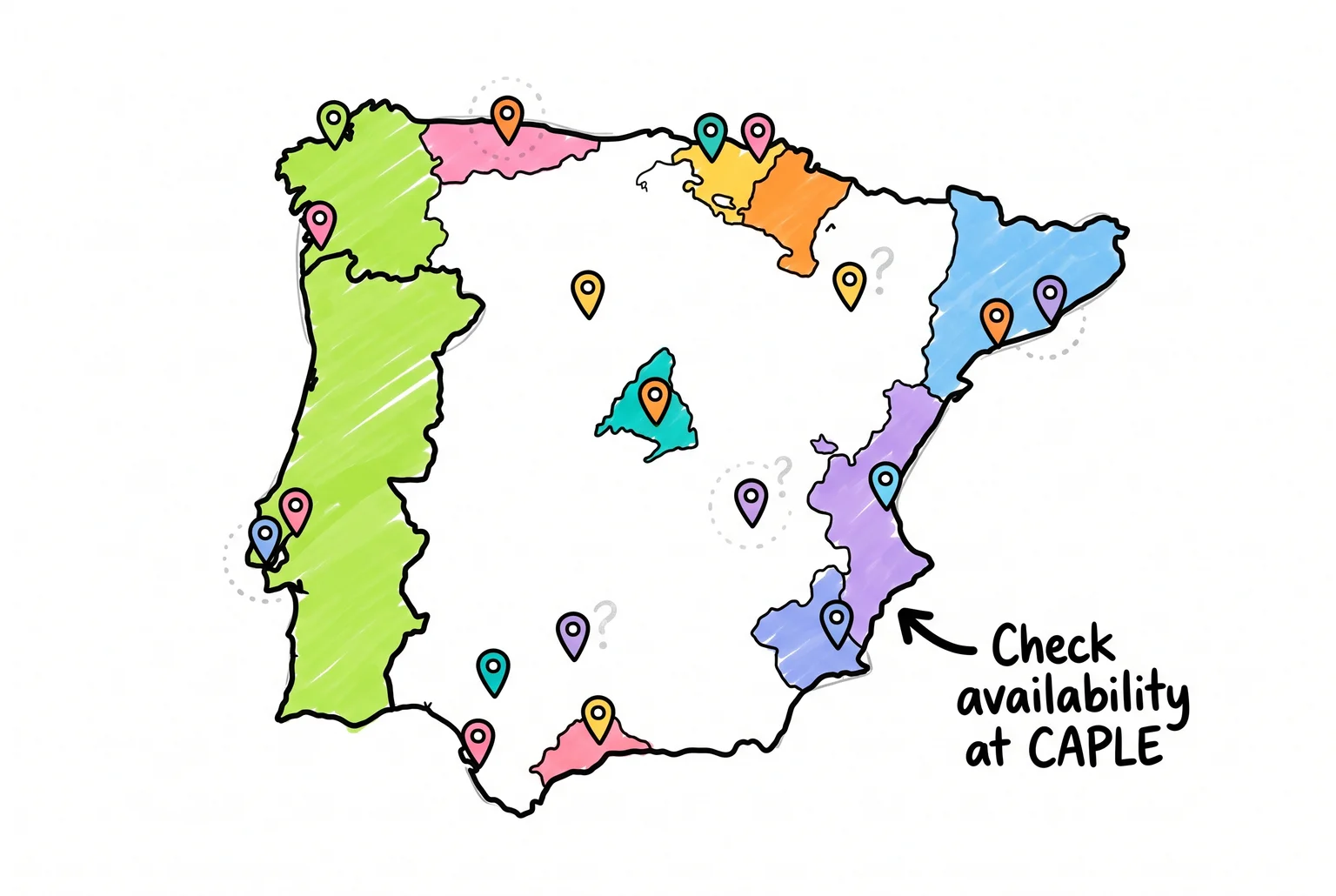
Exam centres are scattered across Portugal and abroad, but only the official registration site shows which ones are actually open for your session.
Once you’ve picked a centre, you select an available exam date from whatever sessions are open at that location. Then comes the personal details form. Enter your name, document type, and document number exactly as they appear on the ID you’ll bring on exam day. A typo here, or a name that doesn’t match your passport or residence card, can cause problems at check-in, so double-check every field before moving on.
Before submitting, you’ll need to tick a series of declarations, essentially confirming that the information you’ve entered is accurate and that you accept CAPLE’s exam conditions. Read them rather than clicking through automatically. Once submitted, the registration isn’t finished. You typically need to complete payment within a set window to lock in your spot. One CIPLE registration guide describes this as a 24-hour deadline, but treat that figure as indicative rather than fixed, since payment windows are exactly the kind of detail that can change between sessions.
After you pay, check your inbox. CAPLE sends a confirmation, and you should hold onto that confirmation or registration number. You’ll likely need it if you have to contact the exam centre, check your results later, or resolve any discrepancy about your booking.
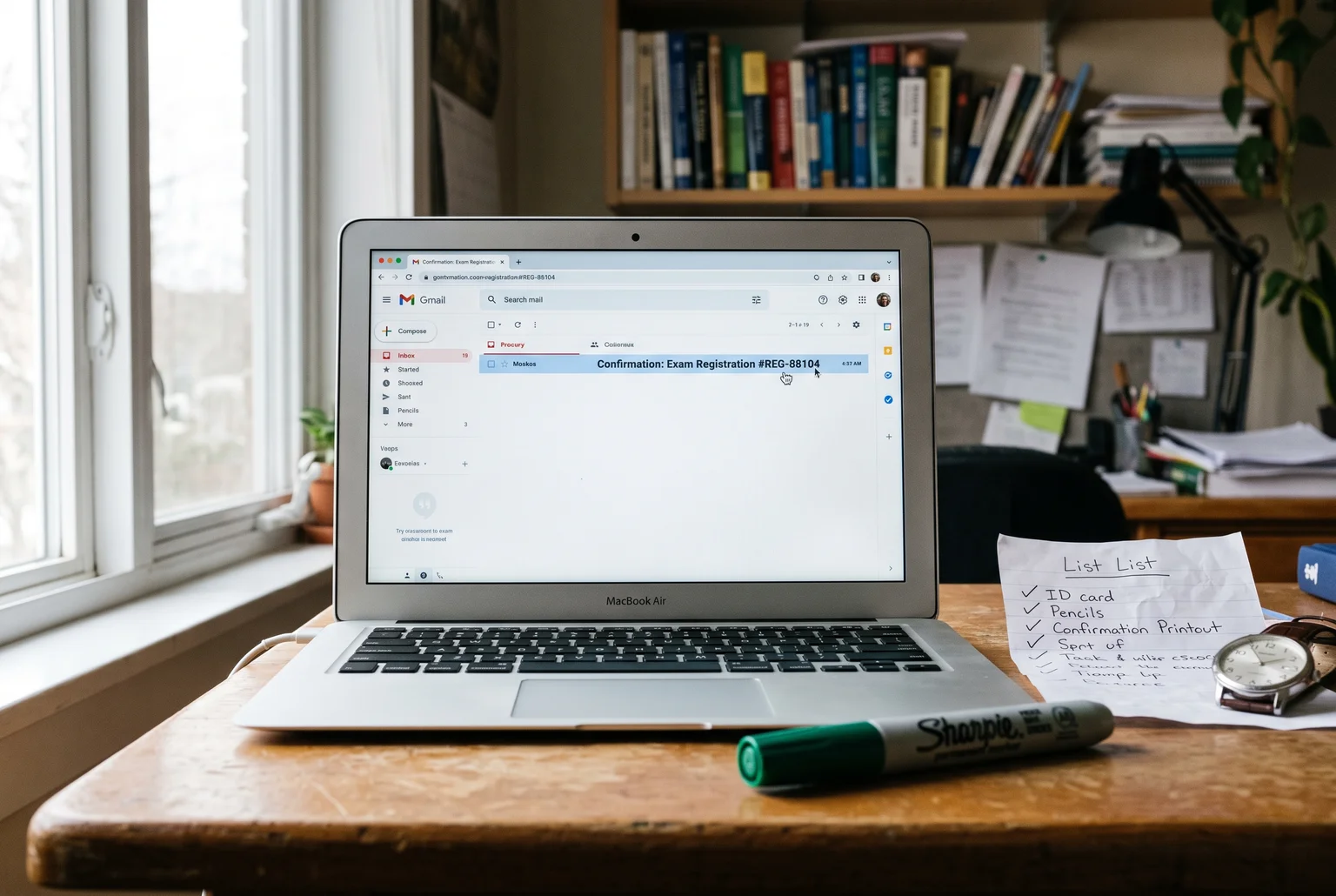
None of the specifics here, fees, exact dates, how far in advance sessions open, are things you should lock into your planning based on this guide or any third-party blog. Registration windows open and close on their own schedule, prices get adjusted, and centres come and go depending on demand. Before you register, go directly to caple.letras.ulisboa.pt and check the live details for the session you actually want. It’s the only source that reflects what’s true today rather than what was true when someone wrote about it last year.
Getting ready for exam day, skill by skill
A school like Portuguese Connection School, with extensive experience in preparing students for CAPLE exams at all levels, including the A2 CIPLE exam, is an ideal choice for anyone looking to improve their Portuguese and prepare effectively for the exam. With experienced teachers, structured preparation and a strong focus on the skills required by CAPLE, students can build their language confidence while working towards successfully passing the CIPLE exam.
If you prefer not to study with a school that specialises in CIPLE exam preparation, such as Portuguese Connection School, and would rather take the longer route of preparing for the exam independently, here is a short guide to help you along the way:
Whether you’re sitting CIPLE directly or backing it up with a PLA course, the prep work looks similar. Effective study for this exam combines exam-style mock tests, A2 grammar and vocabulary work, regular listening practice, and speaking with another person. Doing all four matters more than doing any single one well, since the exam tests them separately and passing requires a baseline in each.
Start with a full mock exam before you study anything else. CAPLE’s own site has sample material worth working through. A mock exam early on tells you the format, the timing, and which of the four skills is weakest, which is more useful than guessing where to focus.
For reading, the skill that matters most is scanning rather than translating every word. Read the question first, note what specific piece of information it’s asking for such as a date, a price, or a name, then search the text for that detail instead of reading start to finish. This approach, backed by A2-level reading strategy guides, saves time on texts like rental ads and bulletin notices that CIPLE tends to use. You don’t need to understand every word in a passage to answer the question correctly.

Listening works the same way in reverse. Read the listening question before the audio plays, identify the keyword you’re listening for such as a time, a place, or a number, and focus your attention there rather than trying to catch every sentence. A2 exam guides for other languages recommend this exact technique, and it applies directly to CIPLE’s format.
Writing rewards preparation with model texts more than raw grammar study. Look at sample A2 writing tasks, notice the sentence patterns used for things like describing your day or writing a short note, and practise adapting those same structures to new topics rather than building sentences from scratch under time pressure. Cover every point the prompt asks for, keep sentences simple and accurate rather than ambitious and shaky, and leave a couple of minutes to check your work.
Speaking preparation benefits from building topic packs. A2 speaking tasks typically stick to a predictable set of subjects: your personal information, daily routine, family, work or studies, shopping, hobbies, and travel. Write out vocabulary and a few sample sentences for each topic, then say them aloud, ideally with a tutor or conversation partner who can push back with follow-up questions. This is the one skill where practising alone hits a ceiling, since the exam is a live exchange with an examiner and you need to get used to responding on the spot.
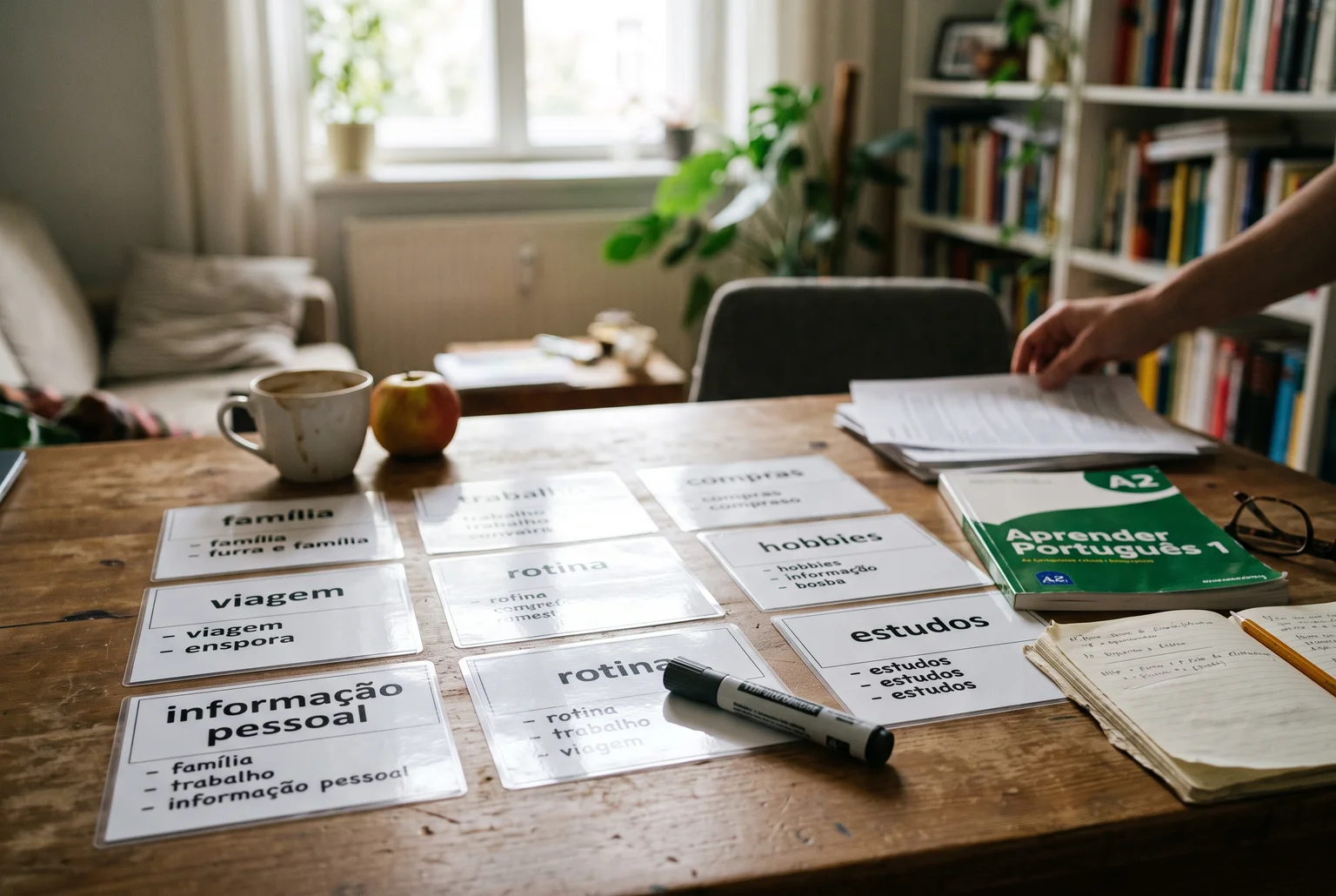
For grammar and vocabulary, an A2-level textbook or workbook covers the ground more efficiently than piecing things together from forums. Titles like Gramática Aplicada and Aprender Português 1 come up often in learner discussions as solid starting points. Pair a textbook with short daily sessions using interactive tools, sites like Easy-Quizzz and Prep2Go offer quick A2-level quizzes that work well for 15-minute reviews between longer study blocks.
None of this works well without a schedule. Set a specific weekly plan rather than studying whenever you have a spare hour, assign a time slot to each of the four skills, and repeat it consistently for several weeks. A four-week plan with daily tasks, common in A2 exam prep guides for other languages, is a reasonable structure to borrow: reading and vocabulary early in the week, listening and grammar midweek, writing practice and a speaking session before the weekend, then a mock test to check progress.
What the actual exam questions look like?
CAPLE publishes its own sample materials, and that’s the source to trust over anything else. Third-party sites also sell or publish practice tests built to mimic CIPLE’s structure, but these are simulations by outside providers, not official CAPLE documents. The examples below are illustrative, built on general A2 CEFR conventions and patterns reported across these sources, not a preview of what will actually appear on your exam. Check the official CAPLE exam samples page before you rely on any practice set, including this one.
Reading questions tend to give you a short, practical text and ask something concrete about it. You might read a classified ad for a rented room and answer a multiple-choice question about the monthly rent, or read two short notices and match each one to a one-line summary of what it’s about. Another common format asks you to decide whether a statement about the text is true or false. Some versions give you three short texts and ask which one fits a specific situation, such as which apartment listing allows pets.
Writing tasks at A2 level typically come in two parts. The first is a short message, maybe 30 to 40 words, such as a text to a friend cancelling plans and suggesting a new time. The second is a longer informal piece, often an email or short letter of around 60 to 80 words, asking you to describe something like your weekend, your job, or a recent trip. Preparation materials describe this two-task structure consistently, though CAPLE’s own site is the place to confirm task lengths and exact instructions.
Listening exercises usually pair a short recorded conversation or announcement with a question you answer while or after listening. A typical setup: two people arranging to meet, and you’re asked to select the correct time and place from a set of options. Others use an announcement, like a shop closing early, and ask you to pick out one detail. Official CAPLE sample listings separate the listening component from the reading and writing section, sold or shared as distinct files, so don’t expect one continuous document covering everything.
Speaking practice, as covered in the earlier section on preparation, revolves around a short back-and-forth with an examiner. Materials from online providers describe typical prompts such as introducing yourself, asking for directions to a place, or agreeing on a plan with someone. You might be asked to play a simple role, like buying a train ticket and asking what time it departs, rather than answering questions in the abstract.
One thing worth knowing before you rely too heavily on any practice set: official sample materials are mostly structural guides. They show you the format and the kind of task you’ll face, but they generally don’t include scoring guides or corrected model answers for the writing and speaking sections. Practice with them to get comfortable with timing and task types, but don’t treat a sample answer as a guaranteed pass mark, and don’t assume every third-party mock test matches CAPLE’s actual difficulty or phrasing exactly.
Answers to the questions applicants ask most
Does the CIPLE certificate expire? No. CAPLE certificates and diplomas, including CIPLE, are lifelong and don’t carry an expiration date, according to a discussion with the Instituto de Cultura e Língua Portuguesa on the Nomad Gate forum. The two-year figure that sometimes comes up in administrative conversations refers to something narrower: the window during which you can get a replacement certificate reissued free of charge if the original is damaged or contains an error. Past that window, you can likely still get a replacement, just probably not for free. Your original pass stands regardless of how many years have gone by since your exam.
What happens if I fail? Nothing catastrophic. Failing the CIPLE exam does not reset your residence clock, invalidate your citizenship or residency application, or affect your current permit status, according to Prep2Go’s breakdown of retake rules. CAPLE doesn’t impose a formal limit on retakes or a mandatory waiting period, so you can sit the exam again as many times as you need, subject to seats being available in an upcoming session. If you think your speaking score was marked wrong, you can request a formal re-correction from CAPLE within a specified window, for a fee.
Do I have to use CIPLE specifically? No. There are several ways to meet the A2 language requirement for citizenship, and CIPLE is just one route. Completing a certified 150-hour PLA course is one alternative, as covered earlier. Portuguese-language secondary or higher education can also count as evidence, and an authorised A2-level (or higher) language certificate from another accredited body may satisfy the requirement without you ever sitting the CIPLE exam. If you’re unsure which route fits your situation, a lawyer who handles nationality cases can tell you faster than guessing.
Are there exemptions for age, health, or disability? Yes, for specific situations. Applicants 60 or older who cannot read or write get an adapted, largely oral version of the test rather than the standard written format, according to LVP Advogados. Applicants with disabilities or serious health conditions that make the standard test impossible can be exempted entirely, but you’ll need to back that up with a multipurpose medical certificate or a medical report, not just a self-declaration.
What about minors applying for citizenship? Language requirements for minors can vary depending on the child’s age, schooling and, importantly, the legal basis of the citizenship application. There is no single rule requiring every minor to provide an A2 certificate.
For younger applicants, school attendance or other evidence of Portuguese-language knowledge may be accepted in certain citizenship procedures instead of a language certificate. Where formal language certification is required, CAPLE offers age-appropriate examinations: TEJO for children aged 9-11, which assesses levels A1, A2 and B1, and CIPLE-e for young people aged 12-15, which certifies A2. From the age of 16, candidates who need to formally demonstrate A2 Portuguese can take the regular CIPLE (A2) examination.
Candidates with specific needs may also be eligible for special or adapted examination conditions, subject to the applicable rules.
Because the documentation required depends on the particular citizenship route, parents or legal guardians should always confirm with the Portuguese authorities which form of language evidence is required for their child’s application.
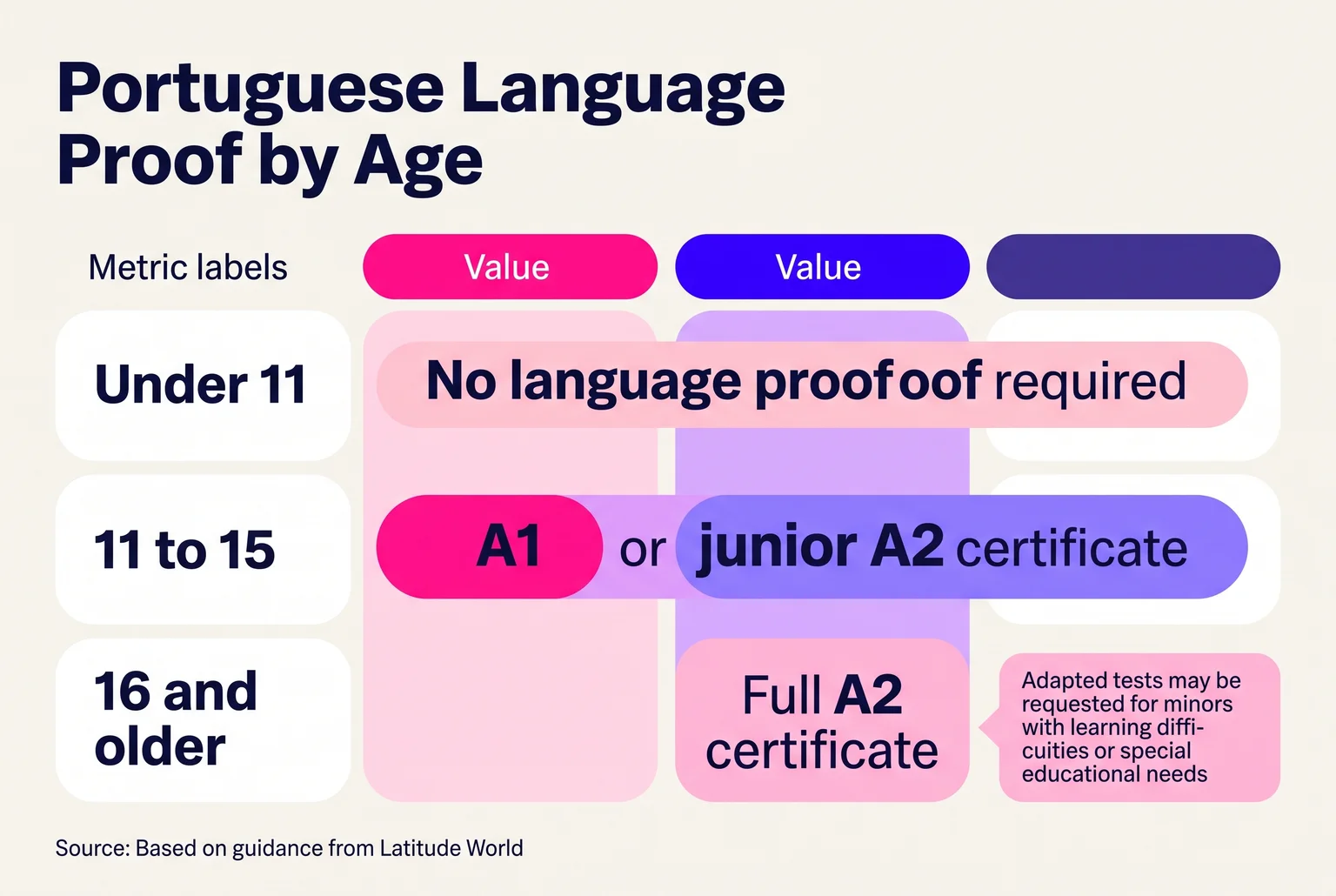
The language proof required for young applicants scales with age, from none at all to the full A2 certificate at 16.
Is the language test the only requirement for naturalisation? No. Passing the A2 test is one piece. Most applicants also need a clean criminal record and have to show some familiarity with Portuguese culture, according to Global Citizen Solutions. The language exam gets the most attention because it involves scheduling an exam and studying for months, but it sits alongside these other conditions, not in place of them.
How much does the exam cost, and when is it offered? Fees and exact dates are the two things in this guide worth double-checking yourself before you rely on anything you’ve read online, including here. Reported figures put the exam fee somewhere between roughly €72 and €85 depending on the centre, and CIPLE reportedly runs around nine sessions a year, but CAPLE and individual exam centres set and adjust these details, so confirm current pricing and the exam calendar directly on the CAPLE official site before you register or budget for a retake.
If you take one thing from this guide, take this: the A2 requirement has more flexibility built into it than most people expect going in, from exemptions for age and health to entirely different certification paths, but the fine print on fees, dates, and eligibility changes often enough that CAPLE’s own site should be your final check before you commit to a plan.
Skipping the exam entirely: the 150-hour course route
Sitting the CIPLE exam is not the only way to prove A2 Portuguese. Portuguese nationality law also accepts a completion certificate from a course called Português Língua de Acolhimento, usually shortened to PLA, at levels A1 and A2 combined. AIMA describes this pathway, called Percurso A, as running up to 150 hours, and providers commonly split it into six 25-hour modules covering both levels together. Finish the course, pass the internal assessment, and you walk away with a certificate that several immigration lawyers and course providers describe as legally equivalent to passing CIPLE, without ever sitting the CAPLE exam itself.
The appeal is obvious if you’ve read the earlier sections on exam format and registration. No LAPE centre to travel to, no fixed exam date competing with your schedule, no oral component in front of an examiner you’ve never met. Courses run online or in person depending on the provider, often scheduled around 10 hours a week for roughly 15 weeks, though some run as 16-week live-online formats. You study at a pace closer to a normal evening class than a single high-stakes test.
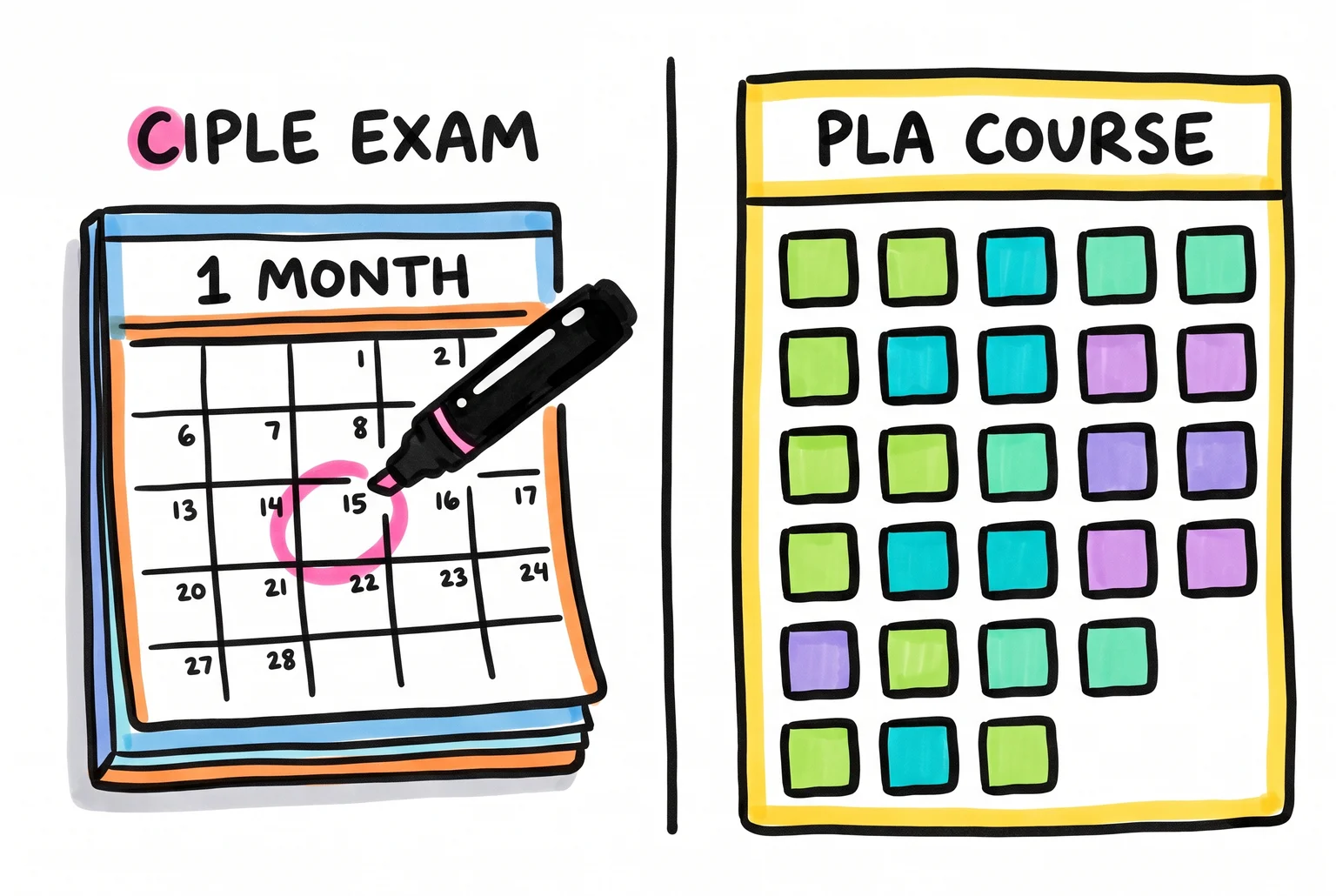
One path hinges on a single exam day, the other spreads the same requirement across fifteen weeks of regular classes.
Eligibility isn’t automatic. PLA courses generally target people aged 16 or older whose first language isn’t Portuguese, but enrolment also requires documentation: a residence permit, proof that a residency process has started, an international protection application, or at minimum proof of a NISS number. Some providers, including CIPLE School, note that holders of certain seasonal work or temporary stay visas may also qualify. If you don’t have any of these yet, the course route may not be open to you before the exam route is.
There’s a real tradeoff here, not just a convenience upgrade. CIPLE is a single test you can prepare for intensively over a few weeks. A PLA course is a 150-hour commitment stretched over months, taught by an accredited institution rather than self-study, and it ends in continuous coursework assessment rather than one exam day. If your Portuguese is already close to A2 and you learn well independently, sitting CIPLE directly might get you a certificate faster. If you’re starting closer to zero, or you find classroom structure more reliable than solo prep, the course gives you built-in instruction time the exam route doesn’t.
For those who prefer the PLA route rather than sitting the CIPLE exam, choosing the right school can make a significant difference. CIPLE School offers a particularly convenient option, combining certified courses with high-quality Portuguese language teaching and greater flexibility to accommodate students’ individual needs.
Students benefit from experienced and qualified Portuguese teachers, structured A1 and A2 programmes, and course schedules designed to fit more easily around work and personal commitments. This makes CIPLE School a strong choice for candidates who want to obtain recognised proof of A2 Portuguese through a structured course rather than preparing for and sitting the CIPLE examination.